I Hauled a $350 Air Purifier Through 20 Flights to Fix Hotel Insomnia
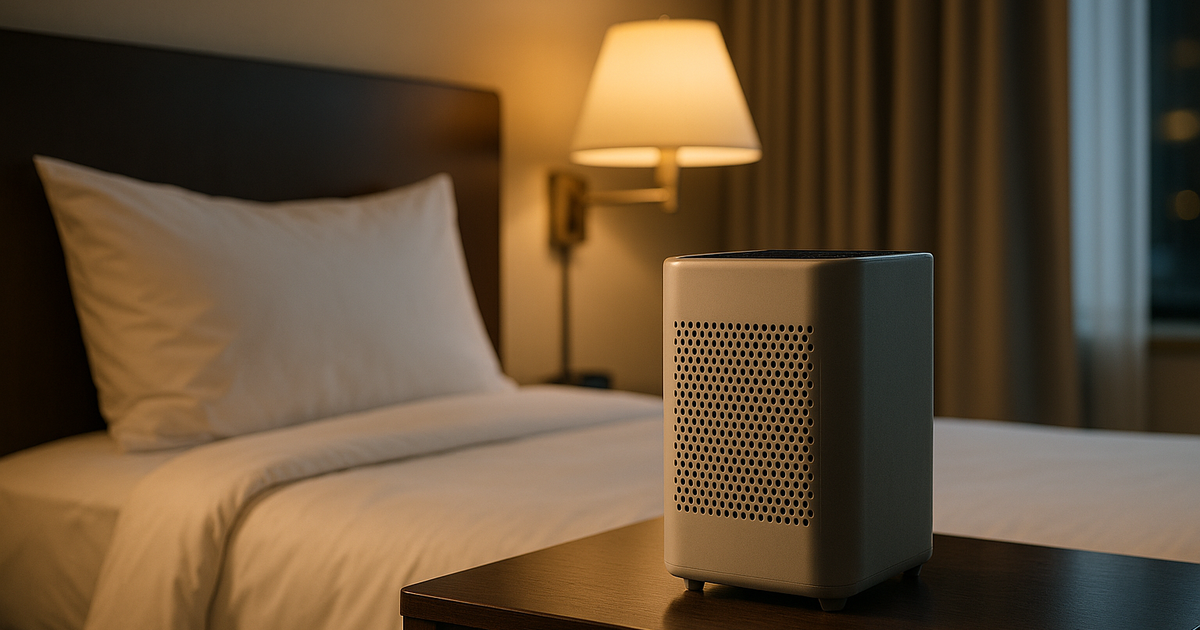
On high-frequency trips out of NYC, hotel room air quality is a gamble I stopped taking. The AirMed 1 Compact isn't for casual flyers. But if you spend ten days a month breathing recycled Marriott air, it pays for itself in preserved sleep. Tentatively yes, it stays.
Why I bought it (context + expectation)
On back-to-back travel weeks, you quickly realize you don't control your baseline environment. After 20 segments last year, what broke first was my sleep cycle. Occasional jet-lag insomnia is one thing. Breathing stale, heavily fragranced, or dusty air in an older building makes recovery impossible.
I judge tools by airport-day behavior. Showing up exhausted to a morning meeting because my room smelled like old smoke wasn't working. I needed a way to scrub the air. Portable matters more than feature depth, but I still required actual HEPA and carbon filtration—not just a plastic fan.
I bought the AllerAir AirMed 1 Compact. It costs roughly $350. That is a steep premium, but my home in NYC is secondary to road kit reliability. I needed an industrial solution shrunk down to carry-on size.
How long I used it (timeline + frequency)
O'Hare delay. Midnight arrival at a highway-adjacent hotel. The room smelled like wet carpet and old cologne. I plugged the AirMed 1 in before even unlacing my boots. Within twenty minutes, the air went neutral.
I've hauled this unit across eight states over the last three months. That equates to about 28 travel days. It takes up significant space in my roller bag, forcing me to be disciplined with my clothing choices. EDC weight is optimized to the gram where possible, so giving up real estate for a cylindrical metal filter was a massive concession.
I keep only what survives three trips in a row. The AirMed 1 survived its trial period because of its carbon filtration. It aggressively handles hotel room mustiness better than anything else I've tried.
Is it worth it (real gain)
Hotel wall noise changes everything. One unexpected benefit is the sound profile. On low or sleep modes, purifiers like this sit between 22 and 30 dB. It acts as a consistent white-noise generator. Hallway elevator dings and slamming doors effectively vanish into the background hum.
Is it worth $350? If your schedule demands ~8–12 travel days/month, yes. By eliminating respiratory irritants like dust mites and mystery odors, it acts as a sleep guardian. A standard fan handles the white noise, but waking up without that dry, dusty hotel throat proves the HEPA filter is actually working.
Pitfalls (hidden costs + friction)
First pitfall: the plug situation. I am USB-C-first for travel and hate adapter soup. The AirMed 1 requires a standard wall outlet. It doesn't charge my devices; it just hogs an outlet that I usually need for my laptop or phone.
Second: maintenance overhead. You have to vacuum the HEPA filter regularly to maintain airflow. If you ignore filter maintenance, performance drops fast.
Third: realistic limitations. If your room is actively absorbing heavy cigarette smoke from a neighbor, a portable unit will reduce the particulate load, but research shows it won't eliminate the gaseous nicotine compounds entirely. It mitigates bad rooms; it does not perform miracles.
Long-term changes (30/90/180 days)
Packing for a four-city sprint out of Newark. I stared at my open carry-on, weighing the AirMed 1 against a spare pair of dress shoes. The shoes lost. Sleep quality trumps footwear.
The biggest behavioral shift is psychological. I no longer dread checking into older rental properties or budget-friendly business hotels. I plug the unit in immediately. I run it on high while I grab dinner down the street. By the time I return, the room feels entirely reset.
I optimize for repeatable travel routines. "Scrub the air" is now step one of my hotel arrival protocol. It removes the anxiety of rolling the dice on a room's HVAC system.
Who this is not for (clear boundary)
If I cannot set it up in five minutes, no. Luckily, this is plug-and-play. However, if you only fly twice a year, do not buy a $350 portable air purifier. Save your money and just ask the front desk to change your room if it smells.
Also, if you prioritize ultra-minimalist, one-bag travel where every cubic inch counts, this hardware will infuriate you. It is entirely too bulky for a 20L backpack.
Alternatives (safer options)
In hotel rooms, size dictates everything. If you refuse the $350 price tag or the sheer bulk, look at the PureZone Mini or the Levoit Core Mini. Both hover around $45.
The PureZone is an interesting pivot because it features a rechargeable lithium-ion battery that lasts up to 12 hours. That cordless freedom is highly appealing for lounge hopping or setting up in a temporary workspace. However, these lightweight units lack the robust carbon-poundage required to deeply neutralize room odors.
I need two more trips to confirm consistency with battery-operated purifiers. For now, they serve as solid backup plans if you cannot justify checking a bag.
One-line verdict (would I buy again?)
A bulky, outlet-hogging luxury that undeniably salvages my sleep quality on the road—if it travels cleanly, I keep it in rotation.
Related navigation: David persona channel, climate-air-water cluster, commute-and-business-travel scenario.