Why I Trashed My Gadget-Heavy Desk Setup
Before adding anything, I ask what it replaces. Ninety days ago, I realized my 48-inch desk was holding me hostage. I gutted my hybrid setup. No ring lights. No second monitors. I am still validating long-term simplicity, but the verdict is clear: bloated desk setups fail in small spaces.
Why I bought it (context + expectation)
A Tuesday morning in October shifted my mindset. Rushing to join a call from my Portland studio desk, I knocked over a heavy $140 standalone microphone. The culprit? Simply trying to plug in my proprietary webcam. I was managing gear instead of doing work.
Space is my primary budget. At 32, living in a single room, every inch dictates the flow of the apartment. My workspace had slowly become a storage shelf for a dual-monitor arm, an audio interface, and a massive ring light. The footprint cost was roughly four square feet of unusable surface area. I wanted a setup that didn't feel like a command center. Boxing things up started that same afternoon.
How long I used it (timeline + frequency)
The culling process ran strictly for 90 days. I removed six distinct gadgets entirely. Applying a strict one-in-one-out rule is my baseline, but honestly, I remove before I add.
Week one involved just my laptop and a notebook. Items were reintroduced only when friction became unbearable. The heavy 27-inch monitor stayed in the closet for a month. I never missed it. Tracking my workflow efficiency over 12 weeks revealed zero drop in output. I spent zero hours troubleshooting driver updates. The only permanent addition was a $45 basic aluminum laptop stand. It elevates the screen six inches and demands nothing in return.
Is it worth it (real gain)
Is a complex home office setup worth the financial and spatial investment? Absolutely not. One extra accessory can be one too many.
Stacking productivity tools creates an illusion of work. It costs money, but more importantly, it costs time. Buying the gadget means buying the cable organizer to hide its wires. Then you buy the cleaning brush to dust the cable organizer. The cycle never ends. Stripping the desk back to a simple stand and a single machine saved me hundreds of dollars. Giving myself back half my physical desk space was the real return on investment. It works.
Pitfalls (hidden costs + friction)
Thursday evening, during month two. I was doing my weekly apartment deep clean. Glancing underneath my desk, I spotted the 18-inch cable management tray. I spent 25 minutes just unweaving wires to wipe down the baseboards beneath it.
My maintenance cap is 40 minutes per week total. Wasting more than half of that limit on cords was a wake-up call. Dust is a massive risk with heavy setups. Every monitor arm and charging dock traps debris.
The second pitfall is ecosystem lock-in. I owned a desk lamp that required a specific app. During week three, it demanded a firmware update just to turn on. I despise forced digital ecosystems. I unplugged it instantly. Hardware should function as hardware.
Long-term changes (30/90/180 days)
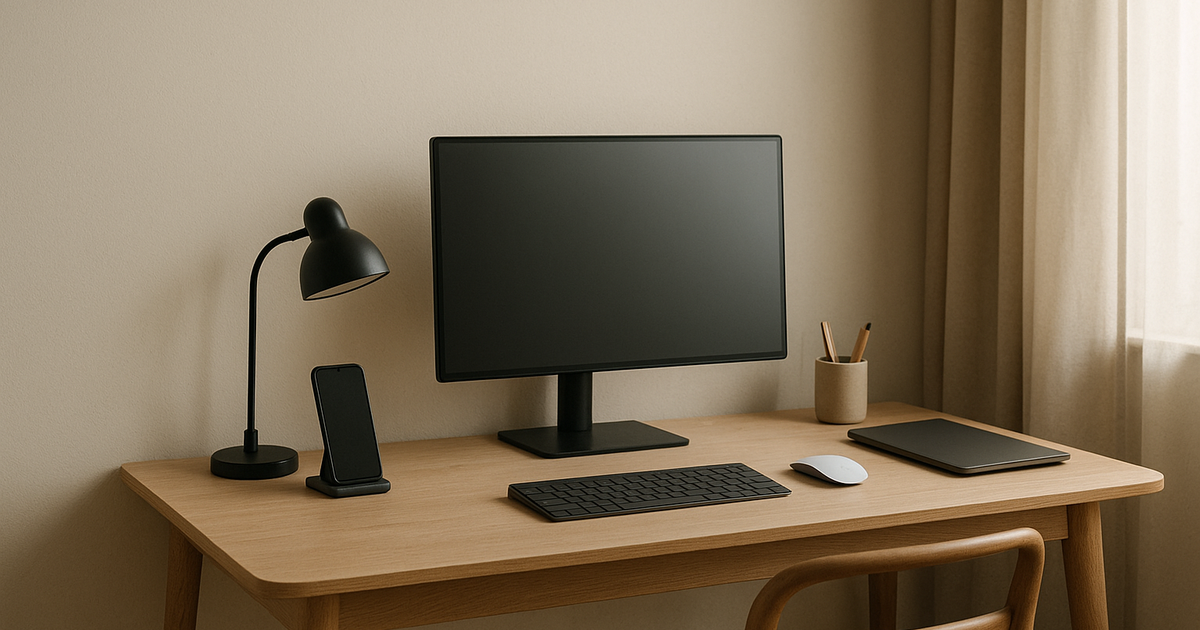
Visual noise dictates my stress levels. Sitting down at an empty surface feels entirely different than sitting down at a cockpit. Clean lines matter because habits follow environment.
My posture adapted smoothly with just the basic stand. Focus deepened significantly. A tool must lower cognitive load, not raise it. Without a second screen flashing incoming Slack notifications, my deep work blocks stretched naturally from 45 minutes to over two hours. The desk is now a blank slate.
Who this is not for (clear boundary)
This aggressive subtraction is not universal. Video editors and heavy spreadsheet users likely need dual screens. Audio professionals require standalone microphones. If a job physically requires specialized hardware, keep it.
Be honest about what is required versus what is just a toy. If it needs a second gadget to work, it's out. Those owning large suburban homes might not feel the spatial pinch. I face a move every 18 months due to renting. Packing up three boxes of heavy mounts is a nightmare. I avoid enthusiast stacking at all costs.
Alternatives (safer options)
Instead of a sprawling setup, invest in a high-quality single machine. Elevate it with a basic riser.
I rely entirely on a simple aluminum stand paired with a $30 wireless keyboard. Both items fit into a standard backpack. Packing them takes ten seconds. A reliable USB-C hub is the only bridge I tolerate. Multi-use functionality is non-negotiable here. One single 65W charger powers the laptop, the keyboard, and my phone. No dedicated bricks. Minimal does not mean underperforming. It just means efficient.
One-line verdict (would I buy again?)
Skip the heavy desk accessories entirely; if it reduces clutter, it stays.
Related navigation: Eva persona channel, digital-productivity cluster, hybrid-work-home-office scenario.