Why I Gave Up on Portable Printers for My College Documents
I originally thought a compact portable printer would solve my document needs without cluttering my desk, but I was wrong. Between dried-out ink in the winter and fading thermal paper, it became an unpredictable financial drain. I cannot recommend these fragile devices for students on a budget.
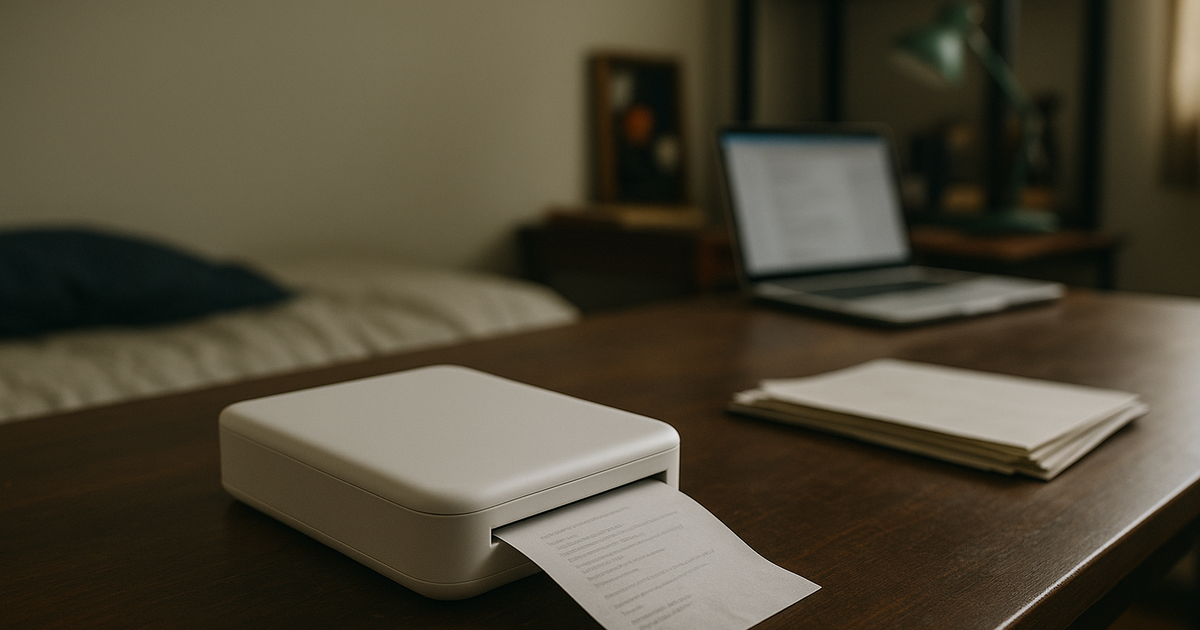
Why I bought it (context + expectation)
In shared campus life, space is a highly contested resource. Sharing an apartment with two roommates means I barely have enough desk space for my laptop, let alone a bulky office appliance. As an international student, I frequently need physical copies of compliance forms for my campus job, which is strictly governed by visa-adjacent rules. I initially thought a portable printer was the perfect compromise. Evidence suggested that models like the Canon PIXMA TR160 at $200 were compact and battery-powered, meaning I wouldn't be tethered to a shared wall outlet. Shared housing changes what is practical, and I genuinely believed a small, mobile unit would make my administrative tasks easier.
How long I used it (timeline + frequency)
I struggled with this experiment for roughly eight months, trying both a compact inkjet and a cheaper mini thermal printer. I am moderately confident that they just aren't built for a student's daily reality, though I need one more term to confirm exactly how much money I wasted. During my trial period, I spent almost 35 minutes a week just troubleshooting connectivity and alignment issues.
Is it worth it (real gain)
For an international student on a tight monthly budget, this category of hardware is absolutely not worth the financial strain. My personal single purchase threshold is around $150, but the real issue was the ongoing expense. Inkjet versions require liquid ink cartridges that are notoriously expensive to replace. Thermal models eliminate ink costs, but the specialized paper creates its own continuous financial drain. I avoid tools that create surprise costs, and when you factor in the ruined paper from jams, the price per page becomes entirely unreasonable.
Pitfalls (hidden costs + friction)
Returning to my shared apartment desk after a brief January break, I sat down near the heating vent to print a mandatory work authorization form. I triggered the print command from my laptop, but the portable inkjet merely clicked and produced a blank page with a faint gray smear. The dry indoor heating, which constantly fights the Buffalo winter outside, had caused the liquid ink cartridges to dry up completely during my two weeks of non-use. Predictability is safety for me, and realizing my $200 device failed exactly when I needed it was incredibly frustrating.
Beyond the ink drying out, the environmental sensitivity of these devices is severe. Official guidelines state these printers need an optimal temperature around 68 degrees Fahrenheit to prevent issues, which is difficult to maintain perfectly in an older building. Extreme temperatures and moisture can permanently damage mobile thermal printers, meaning they are fragile transit companions. If you switch to thermal paper to avoid ink, you face new risks; high humidity causes the paper to warp and curl, which inevitably leads to paper jams and smudged prints. Also, cheap mobile thermal printers often rely on poor companion apps with flaky Bluetooth connections that drop right before deadlines.
Long-term changes (30/90/180 days)
During mid-terms week in early November, I walked across campus through the freezing Buffalo salt and slush to study at the library. When I pulled my thermal-printed study notes out of my backpack, I discovered that the damp cold had curled the edges of the pages, and the text itself was noticeably fading. A good decision should survive exam season, and these fading documents clearly did not. I immediately stopped trying to force the portable printer to work. I shifted my entire routine to utilizing the campus library's commercial laser printers, which proved infinitely more reliable.
Who this is not for (clear boundary)
I do not suggest portable printers for anyone dealing with harsh, fluctuating climates. The Buffalo winter is a real variable that brings both intense outdoor moisture and extreme indoor radiator dryness, both of which ruin ink and delicate printer mechanisms. They are also terrible for students who only print occasionally, since prolonged non-use guarantees the inkjet models will clog.
Alternatives (safer options)
The most reliable alternative is simply adapting your schedule to use university infrastructure. Campus library printers are professionally maintained, immune to dorm-room humidity changes, and require zero setup on your end. If you absolutely must have a printer in your room, coordinating with your roommates to split the cost of a basic, stationary black-and-white laser printer is a far better investment than any portable unit.
One-line verdict (would I buy again?)
If it stays predictable, I keep it; because portable printers proved too fragile and expensive to maintain, I abandoned them entirely.
Related navigation: Yuki persona channel, digital-productivity cluster, student-dorm-shared-living scenario.